RCTab v1.3.2 Section 08 - System Operations Procedures v.1.2.2
RCTab v1.3.2 Section 08 - System Operations Procedures v.1.2.2 document is solely for use in the State of California. This document can be expanded or updated as is necessary or required. Where relevant, this document refers to specific sections and requirements of the California Voting System Standards. Any recommendations listed in this document should not supersede user jurisdiction procedures or other controlling governance entities.
Users should ensure have been followed and completed prior to operating RCTab:
RCTab v1.3.2 Section 05 - Acceptance Test Procedures v.1.2.1
RCTab v1.3.2 Section 16 - System Hardening Procedures - Windows OS v.1.3.0
RCTab v1.3.2 Section 22 - Installation Instructions for Windows OS v.1.3.0
RCTab v1.3.2 Section 23 - HashCode Instructions - Windows OS v.1.2.1
RCTab v1.3.2 Section 25 - Configuration File Parameters v.1.1.1
Any interaction with RCTab, including producing configuration files, running tabulations, hashing results files, and transmission of files from RCTab on USB drives should follow transmission procedures required in jurisdiction, including the use of a team with no less than two trained personnel.
Launching RCTab
The manufacturer recommends RCTab be installed as part of the pre-election preparation process. In order to determine the appropriate launch procedure for a jurisdiction, users should consider the maximum possible number of votes that could occur in the event all eligible voters presented themselves to vote. Jurisdictions should, as part of their pre-election procedure, launch RCTab according to the relevant launch instructions described below to ensure they launch RCTab in accordance with the below requirements. The manufacturer is available for support with this process. For acceptance testing and L&A procedures to set up use of RCTab, see RCTab v1.3.2 Section 11 - L&A Testing v.1.3.2 and RCTab v1.3.2 Section 05 - Acceptance Test Procedures v.1.2.1.
Contests with fewer than 1,000,000 votes
To Launch:
-
Navigate to the rcv folder created when you unzipped the Tabulator.
-
Open the bin folder
-
Right- click on the rcv.bat file. Click ‘Run as Administrator.’ If a ‘Windows protected your PC’ window pops up click ‘More Info’ then click the ‘Run anyway’ button. Enter the administrator password
Contest with more than 1,000,000 votes
-
Open a Command Prompt by navigating to the start menu and typing in Command Prompt.
-
Press enter to launch Command Prompt.
-
Change the current directory to the rcv folder created when you unzipped the Tabulator.
-
First, type in cd (note there should be a space after cd).
-
Using File Explorer navigate to the folder where RCTab is installed.
-
Double click on the rctab_v1.3.0_windows folder
-
Click and drag the rcv folder over to the command prompt window
-
Your command prompt will now read something like:
- cd C:\RCTab\rctab_v1.3.0_windows\rcv
-
Press enter
-
Launch the tabulator by entering the following command:
- .\bin\java -mx30G -p .\app -m network.brightspots.rcv/network.brightspots.rcv.Main .
Prepping CVRs for use with RCTab Software
All export of CVR records for use with RCTab and migration of CVR records for use with RCTab should follow CVR procedures required by the jurisdiction. Users must keep track of the path to each file that is needed to tabulate the RCV contests. You will need it when you configure the RCTab software.
When tabulation begins, RCTab automatically, programmatically verifies the cryptographic signature of all Hart CVRs used as input for contest tabulation. This verification step ensures both the integrity (CVR contents have not been edited) and provenance (CVRs came from the Hart voting system) of the Hart CVRs.
Users should confirm that each Hart CVR .xml file used as input for RCTab has a corresponding .sig.xml file. Instructions to enable signed Hart CVRs are available below in the “CVR Files Options - Hart” heading below.
Setting up a configuration file for RCTab
All settings in the RCTab software are described in technical detail in the RCTab v1.3.2 Section 25 - Configuration File Parameters v.1.1.1, including brief descriptions of how options impact the operational validity of other options. This document will describe how to set up a configuration for a contest using ranked choice voting rules. This guide also includes screenshots of the interfaces described. The values a user inputs into any of these fields depend upon the relevant laws and regulations in place in their jurisdiction, as well as the voting system vendor used to produce cast-vote records for their elections. Users must understand the requirements of their laws, regulations, and vendor CVR data in order to fill out these fields accurately for their needs.
RCTab is organized into tabs: the Contest Info Tab, the CVR Files Tab, the Candidates Tab, the Winning Rules Tab, the Voter Error Rules Tab, and the Output Tab. These tabs each include a set of fields that users fill out - some fields are always required, some fields are required based on previous input, and some fields are always optional. This guide will take the user through basic descriptions of each of these tabs and each of these fields. Additional technical information about these fields can be found in the RCTab v1.3.2 Section 25 - Configuration File Parameters v.1.1.1. As users navigate through each tab they are building a configuration .json file which must be saved when complete. If RCTab is closed and the configuration is not saved, no information will be stored. The next time RCTab is opened all fields will be blank. Once a configuration is saved, it can be used by RCTab to process RCV election results according to the rules laid out in that configuration, provided all rules necessary are filled out.
Each individual contest run through RCTab requires its own configuration with contest-specific information such as contest name and candidate names. This guide will run through setting up the winning rules and voter error rules requirements that will apply to your jurisdiction, and will discuss procedures for how to properly fill out other fields in the software. Operation of RCTab must be conducted by a team of no less than 2 trained personnel.
The following guide describes how to operate RCTab. See also RCTab v1.3.2 Section 11 - L&A Testing v.1.3.2 document for additional detail on system operations.
Contest Info Tab
Below is what the contest info tab looks like when a user first navigates to it. This is also the first screen a user will see upon successfully launching RCTab. Contest info fields are in the middle of the screen. The black box at the bottom of the screen is called the operation log box. It sends the user messages about the tabulation process, any errors encountered in using a configuration file, any errors in tabulation, and other software errors. Information in this panel is saved to the rcv_0.log file. Users cannot turn this feature off using the RCTab software. The panel on the right side of the document is the “Hints'' tab which includes information for how to fill out each screen successfully.
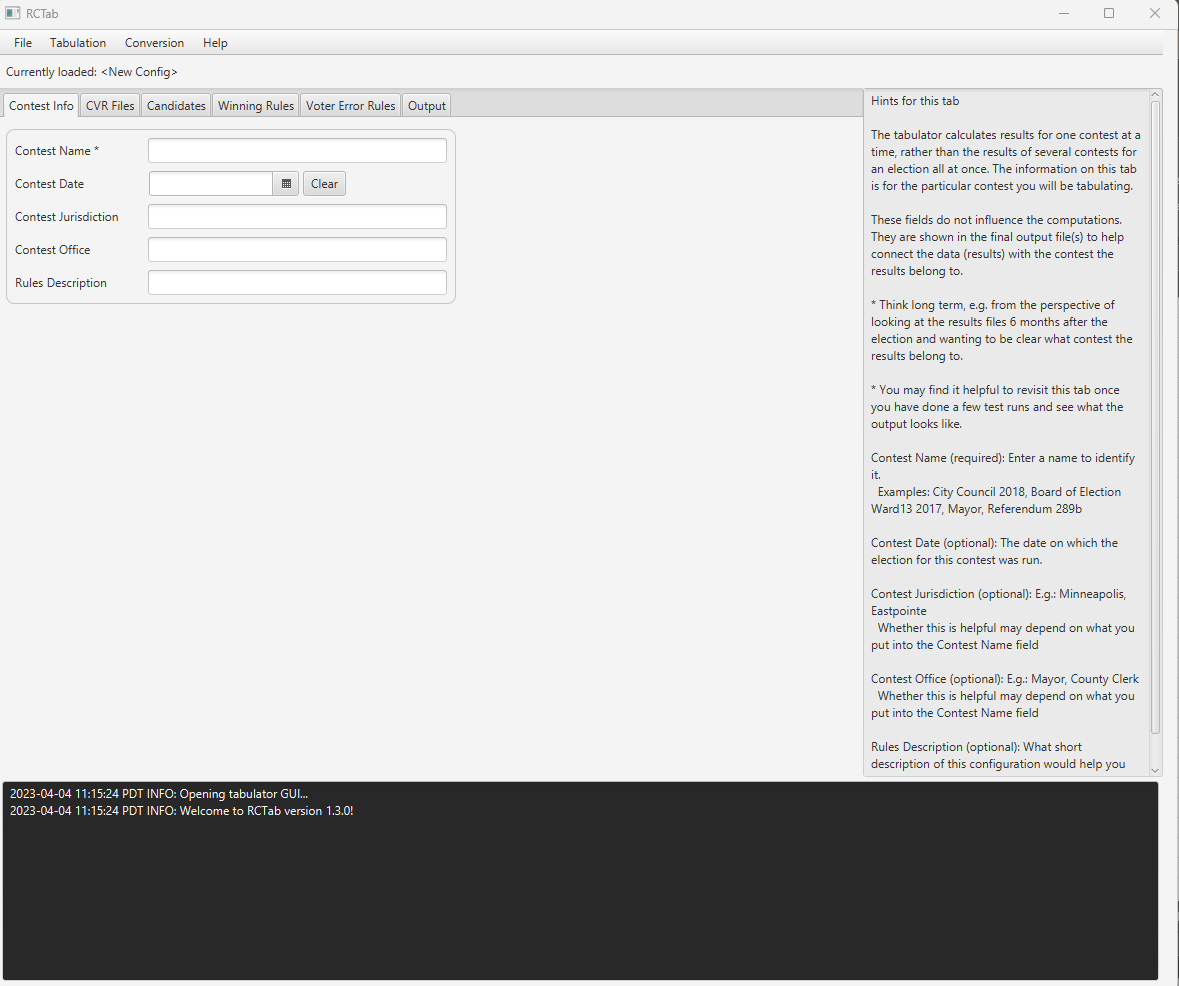
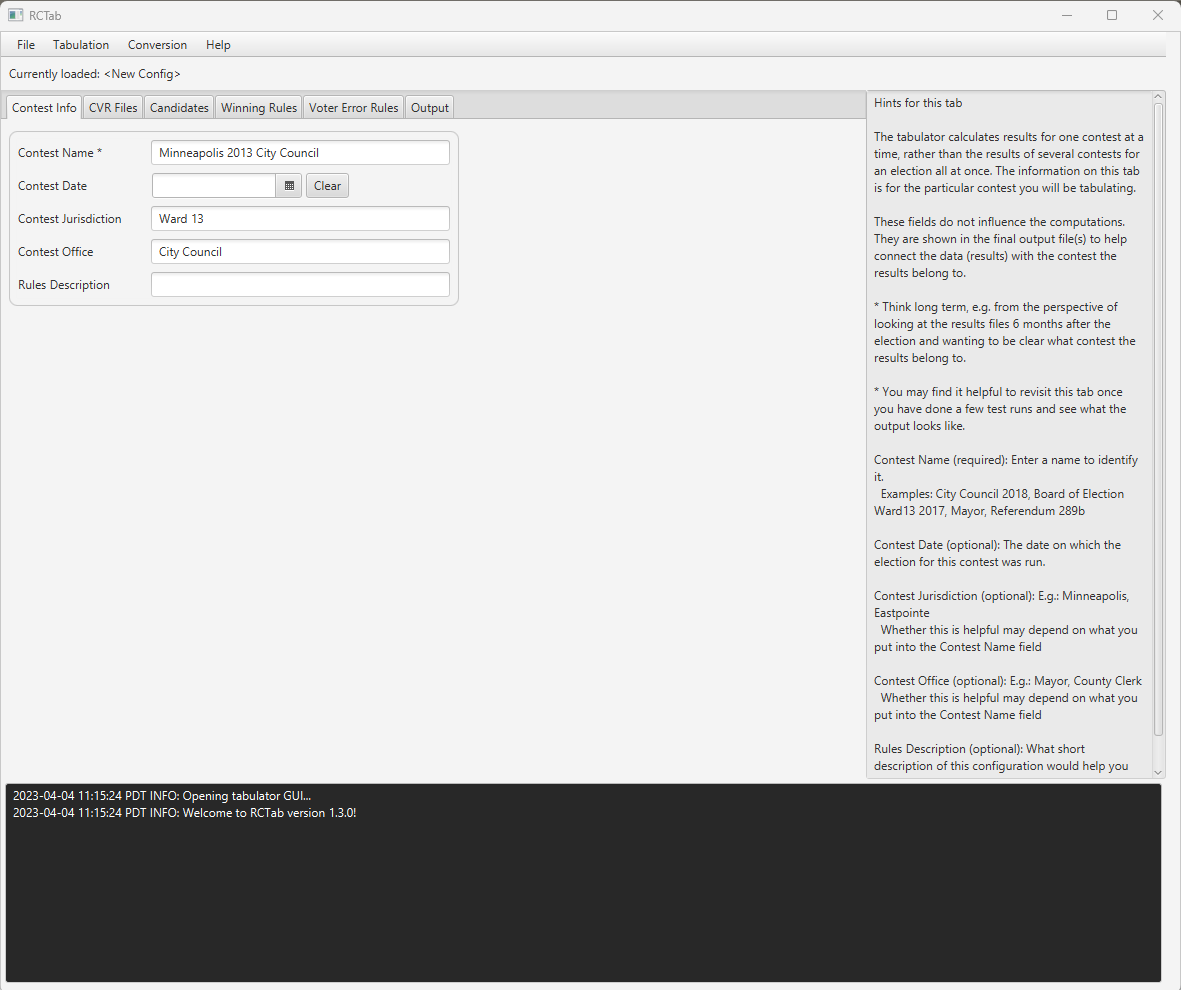
These settings appear on the “Contest Info” tab inRCTab.
-
Contest Name
-
Contest Date
-
Contest Jurisdiction
-
Contest Office
-
Rules Description
The tabulator calculates results for one contest at a time, rather than the results of several contests for an election all at once. The information on this tab is for the particular contest you will be tabulating.
These fields do not influence the computations. Contest Name, Contest Date, Contest Jurisdiction, and Contest Office are shown in the final output file(s) to help connect the data (results) with the contest the results belong to.
-
Think long term, e.g. from the perspective of looking at the results files 6 months after the election and wanting to be clear what contest the results belong to.
-
You may find it helpful to revisit this tab once you have done a few test runs and see what the output looks like.
Contest Name (required): Enter a name to identify it.
Examples: City Council 2018, Board of Election Ward 13 2017, Mayor, Referendum 289b
Contest Date (optional): The date on which the election for this contest was run.
-
Clear permits user to clear this field
-
The calendar button allows a user to navigate through a calendar to select the date of the contest
Contest Jurisdiction (optional): E.g.: Minneapolis, Eastpointe
Whether this is helpful may depend on what you put into the Contest Name field
Contest Office (optional): E.g.: Mayor, County Clerk
Whether this is helpful may depend on what you put into the Contest Name field
Rules Description (optional): What short description of this configuration would help you remember in, say, six months what election this specific rule configuration is for? This option’s use impacts no other options. It is included in configuration .json files and audit .log files.
CVR Files Options
This is what the CVR Files tab looks like when a user first navigates to it.
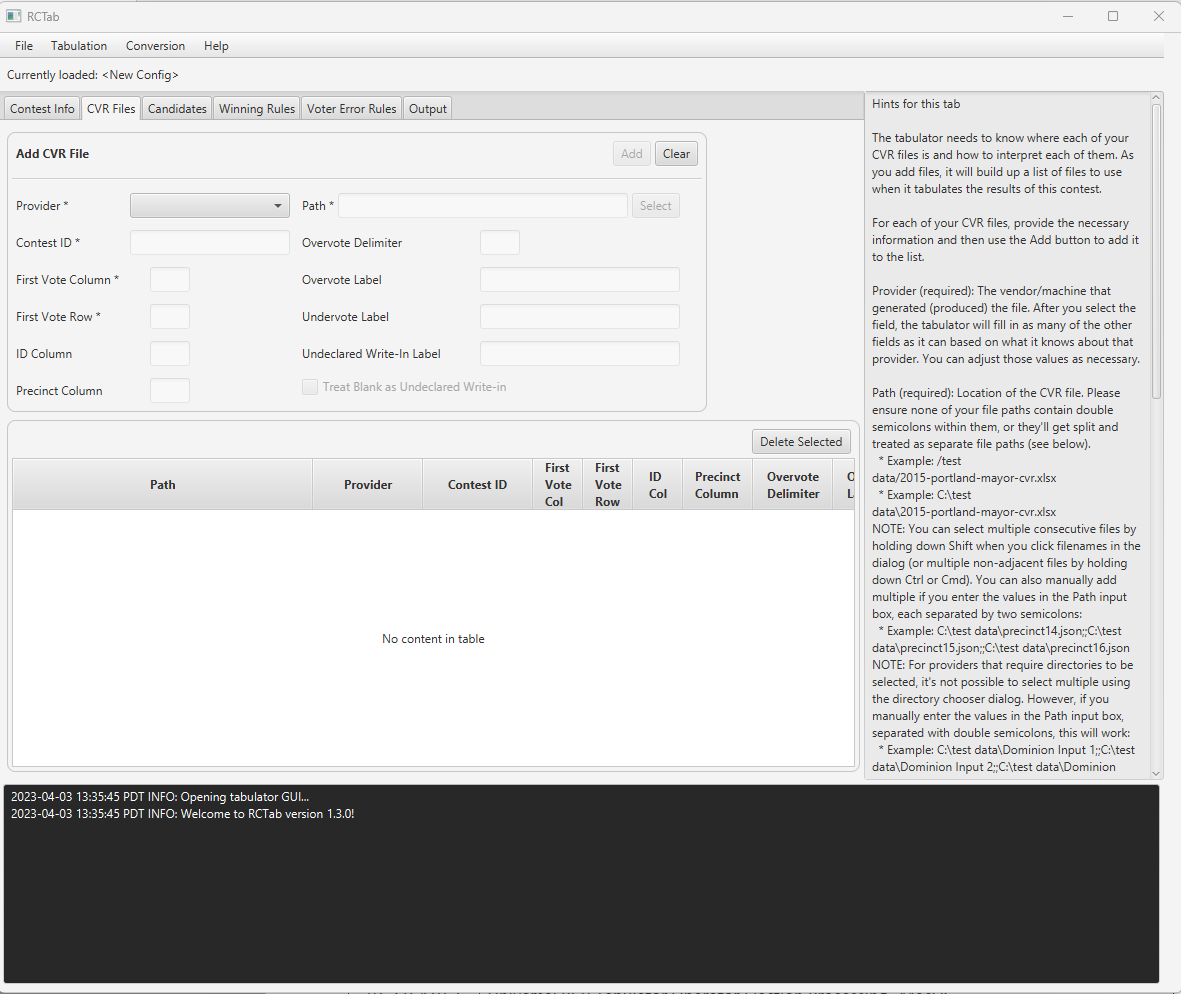
The tabulator needs a configuration file laying out where each of its user’s CVR files for the contest to be tabulated are and how to interpret each of them. Only add files to the configuration that contain data for the contest you are tabulating. CVRs that do not include data for the contest to be tabulated will cause tabulation to fail. Fields used to describe CVRs are on the top half of the tab, while the table on the bottom half of the tab will display each CVR file you have added to your configuration file so far. All information in this tab directs RCTab on where to find files and how to read those files, it does not actually pull in any vote information. Vote information is only used after a user clicks the “Tabulate'' button under “Tabulation” as described later in this guide. This guide will now briefly discuss how to set up RCTab to read a Hart CVR.
Hart
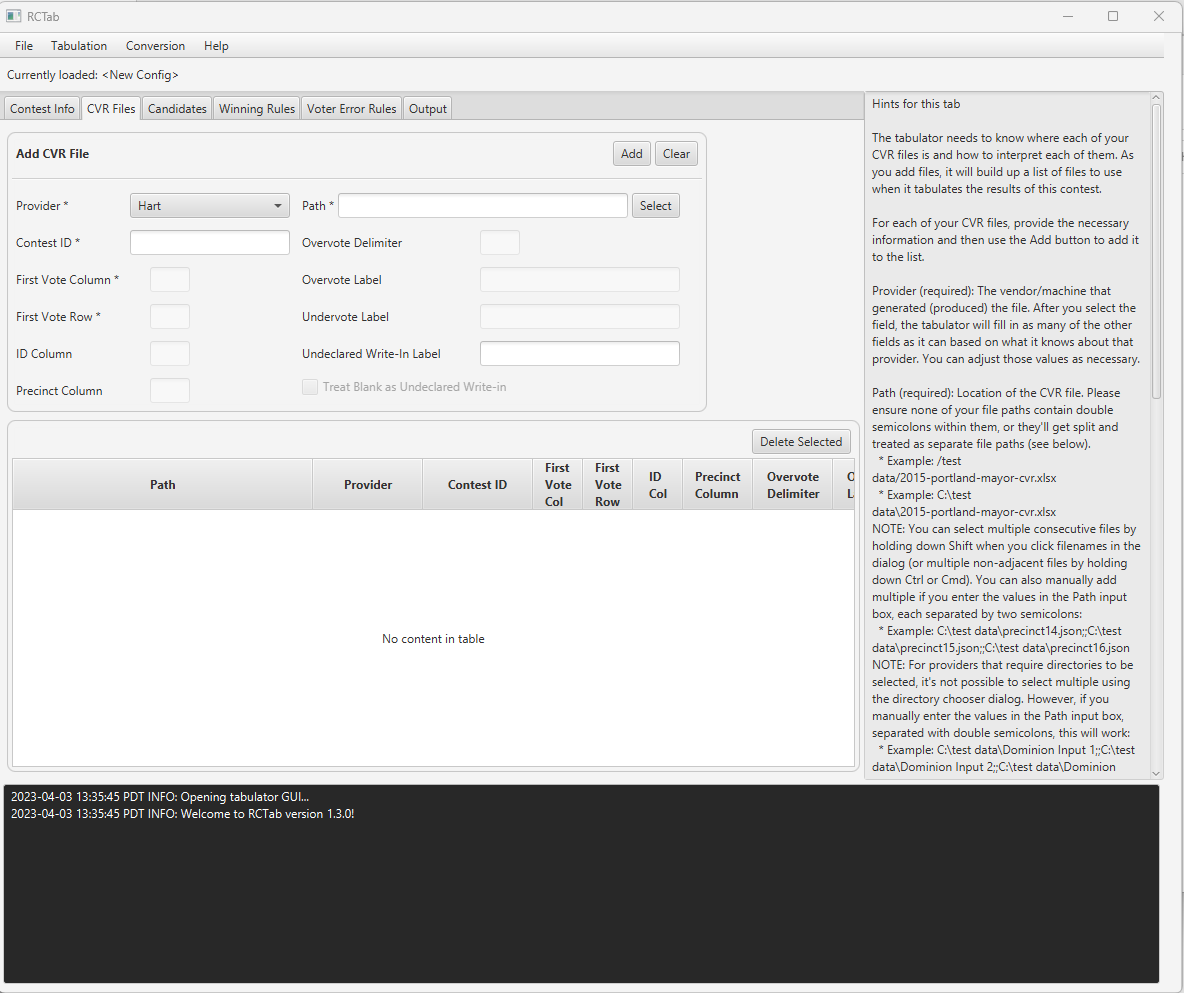 Permits user to edit these
options:
Permits user to edit these
options:
-
Path
-
Contest ID
-
Undeclared Write-In Label
Does not permit the user to edit this option:
-
First Vote Column
-
First Vote Row
-
ID Column
-
Precinct Column
-
Overvote Delimiter
-
Overvote Label
-
Undervote Label
-
Treat Blanks as Undeclared Write-in
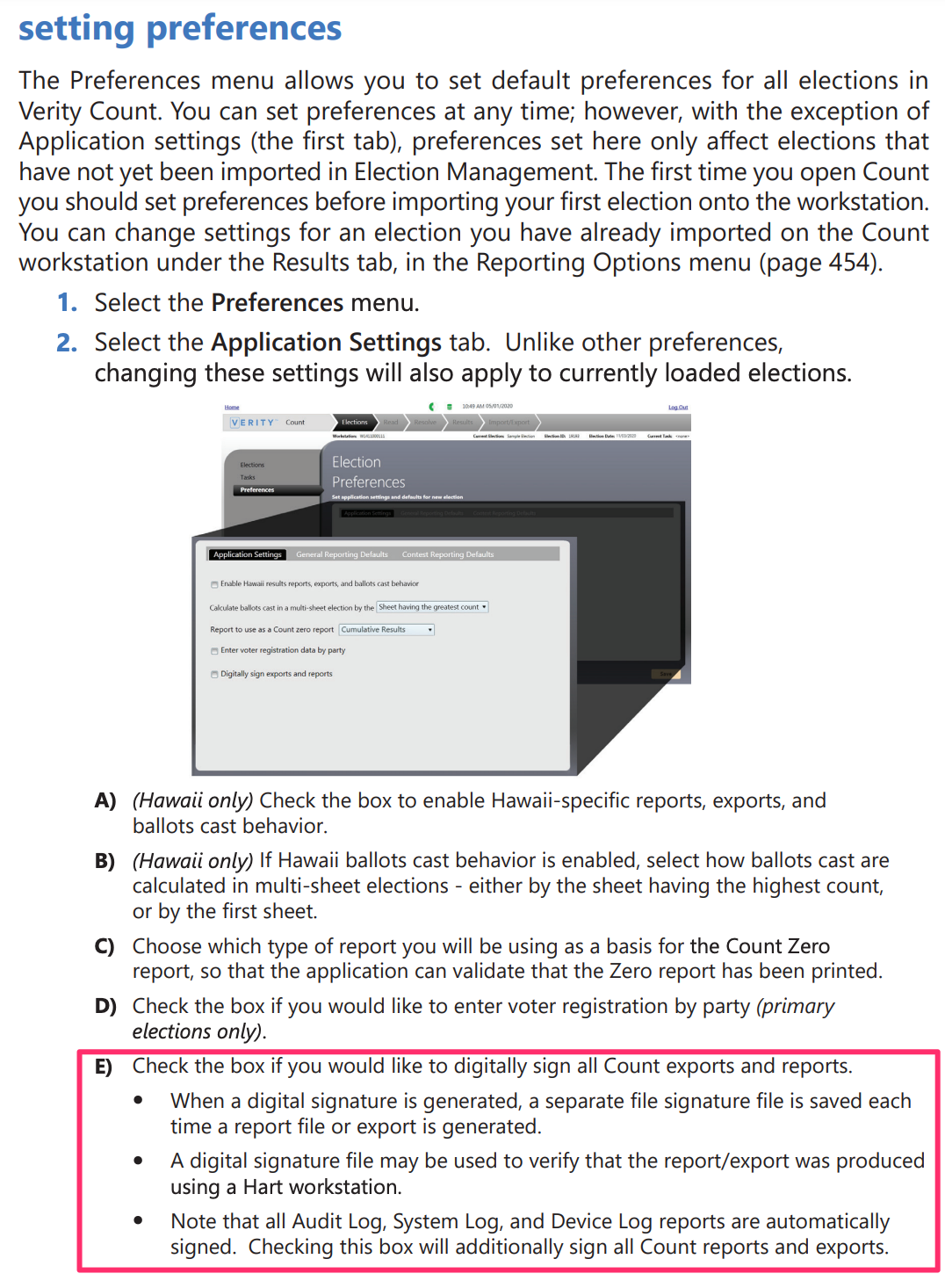
Path: Select the path of the folder that contains signed Hart CVRs. That folder should contain CVR files in .xml format. Each .xml should also have a corresponding [fileName].sig.xml. The [fileName].sig.xml files are used to verify the cryptographic signature of each .xml CVR. Tabuluation will not proceed unless the signature can be verified. Use the Preferences menu in Verity Count to digitally sign CVR exports, described below.
Contest ID (required for Hart): Contest ID must be completed before continuing onto the next step. The contest ID is provided by Hart’s Verity System and is specific to the Ranked Choice Voting contest.
Undeclared Write-in Label (optional): Some CVRs use a particular word/phrase to indicate a write-in. Set to the label used for undeclared write-ins in your CVR
Add: Adds CVR to configuration file. Impacts no other option. Operation impacted by whether required fields (depending on Provider selected) are filled in.
Clear: Clears all fillable values in CVR Files tab above the CVR Files table.
Delete Selected: Deletes CVR file information listed in the CVR table.
Candidates Tab
The candidates tab allows users to put in information about how candidates are referred to in cast-vote record files. These settings impact how CVR files are read. Candidate names entered on this tab will also be used to display candidate names in results files. Below is a screenshot of the Candidates Tab when a user first navigates to it. Candidate Names must match names as represented in CVR files. Users should record all candidate names as recorded in the CVR file in order to successfully input them on this tab. Users should export a candidate listing from the election management system and refer to it when filling out this tab.
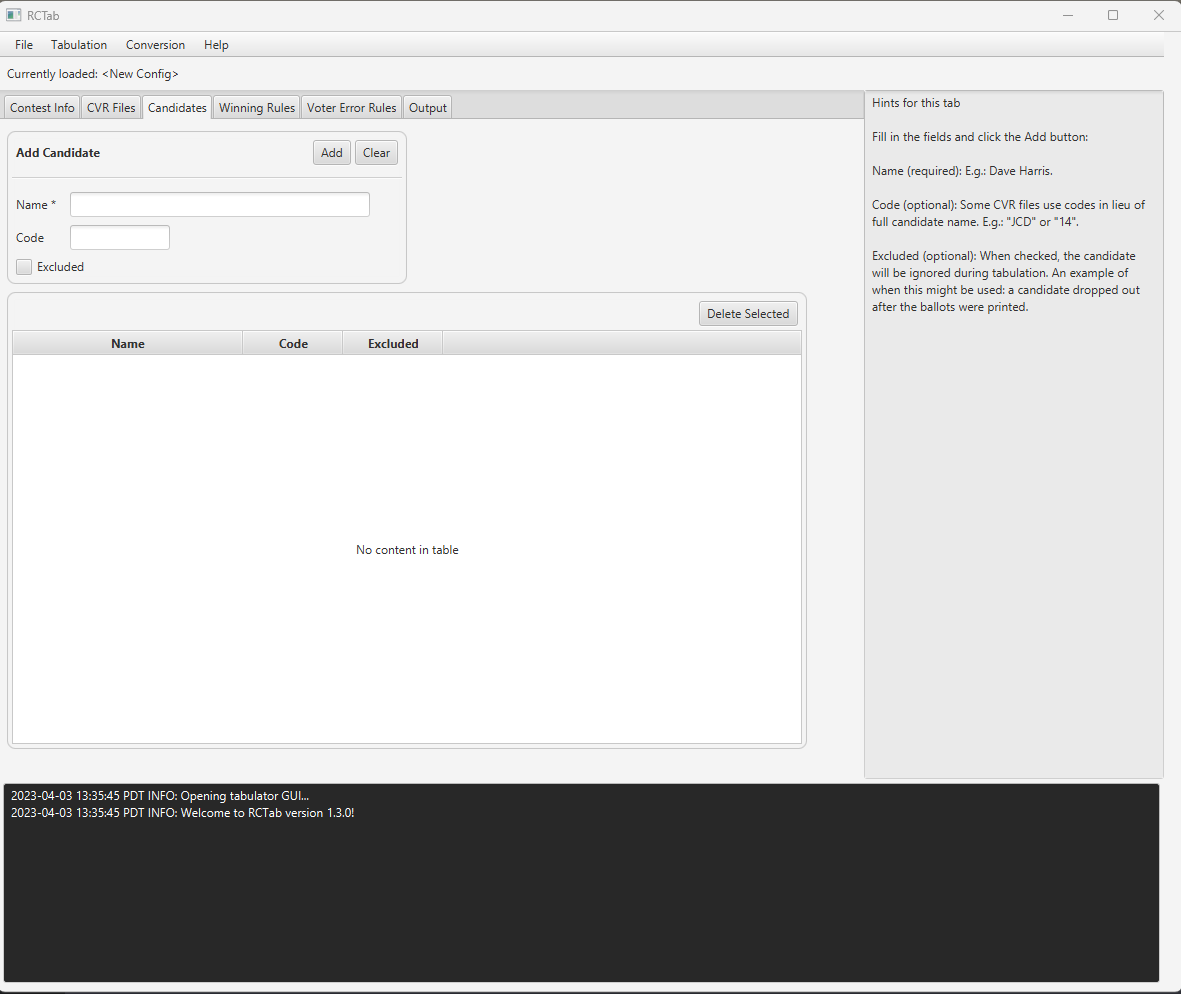
Fill in the fields and click the Add button:
Name (required): E.g.: Dave Harris. This information is used to display candidate names in results files. Fill in with correct names for candidates in this contest.
Code (required for Hart): Hart CVR files use codes in lieu of full candidate name. E.g.: "JCD" or "14" and must be included when adding candidates to RCTab. Candidate codes are provided by Hart’s Verity System.
Excluded (optional): When checked, the candidate will be ignored during tabulation. An example of when this might be used: a candidate dropped out after the ballots were printed.
Add: Adds Name, code, and/or excluded information to the Candidates Table.
Clear: Clears any information in Name, Code, and Excluded.
Delete Selected: Deletes selected candidate data from the Candidate Table.
Winning Rules Options
Winning Rules options tell RCTab what kind of ranked choice voting election to run and how to handle details required for each kind of ranked choice voting RCTab can run.
This is a screenshot of what winning rules will look like when a user first navigates to it.
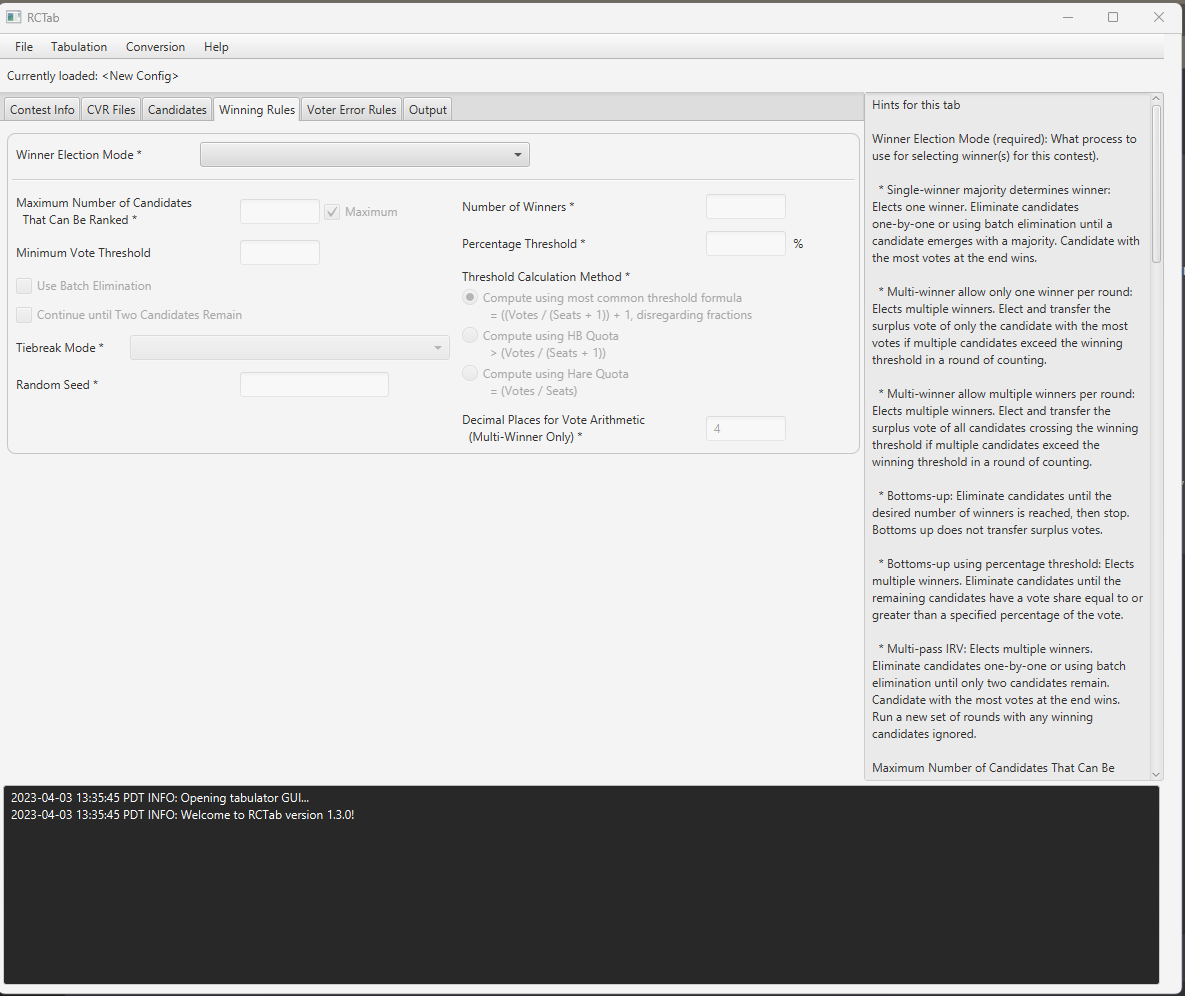
There are two main sets of options on the Winning Rules tab: Winner Election Mode options and Tiebreak Mode options.
Winner Election Mode (required): Before any option is available, users must select the type of RCV election mode they are tabulating. The options currently available are:
-
Single-winner majority determines winner
-
Multi-winner allow only one winner per round
-
Multi-winner allow multiple winners per round
-
Bottoms-up
-
Bottoms-up using percentage threshold
-
Multi-pass IRV
More information about these options can be found in RCTab v1.3.2 Section 18 - User Guide v.1.2.2, under the section Winning Rules Options. Options in this section will be available based on which Winner Election mode is selected.
Maximum Number of Candidates That Can Be Ranked: Users have the option to select the maximum number of candidates available (checked by default), or unselect the checkbox and enter the correct number of rankings allowed by their jurisdiction in the text box.
Minimum Vote Threshold: This setting may be left blank or set to 0 unless jurisdiction rules specify otherwise.
Use Batch Elimination: This setting is unchecked by default but if checked allows for use of Batch Elimination in tabulation.
Continue until Two Candidates Remain: Selecting this option will run the round-by-round count until only two candidates remain, regardless of when a candidate wins a majority of votes.
Number of Winners: The number of seats to be filled in the contest. RCTab automatically sets this value to 1 when “Single-winner majority determines winner.”
Percentage Threshold: The share of votes a candidate must have in order to win by Percentage.
Threshold Calculation Method: Preloaded calculation methods based on the most common multi-winner RCV threshold formulas.
Decimal Places for Vote Arithmetic: Sets how many decimal places after the decimal point are used in surplus transfers and in calculating the threshold.
Tiebreaking
Tiebreak Mode: Users are given the option to select one of six tiebreak methods. They are:
-
Random
-
Stop Counting and ask
-
Previous round counts (then random)
-
Previous round counts (then stop counting and ask)
-
Use candidate order in the config file
-
Generate permutation
Random Seed: Required if Tiebreak Mode is "Random", "Previous round counts (then random)", or "Generate permutation.” Users can then enter a positive or negative integer to generate random orders.
Users should select the “Stop Counting and ask” option. If a tie occurs between candidates before the final round of counting, the software will pop up a window asking users to select which candidate will lose the tie. Users should follow tiebreaking protocols set by their jurisdiction (such as drawing lots) then input the result of that protocol into the software via the popup.
If a tie occurs in the final round of counting, Eureka law requires the winner of the tie be the candidate who led with more first choices in the first round. There is no specific setting for this tiebreaking option in the RCTab software. If a tie occurs in the final round, users should note down the tied candidates then select the “cancel” option in the popup dialog. Users can then inspect the audit log for that tabulation (following the instructions under Retrieving Audit Log and Reviewing Audit Log in RCTab v1.3.2 Section 28 - Post-Election Audit & Clearing RCTab from System v.1.1.1) to determine which candidate led in first choices in the first round. Record that candidate’s name. Re-run the tabulation following the steps in this guide and select the first-round leader when the tie-breaking pop up dialog appears.
For more information about any of these options, see RCTab v1.3.2 Section 18 - User Guide v.1.2.2 and the section Winning Rules Options.
Voter Error Rules
The tabulator needs to know how to handle voter errors in your jurisdiction. These requirements are typically included in statute or regulation. This is a screenshot of what winning rules will look like when a user first navigates to it.
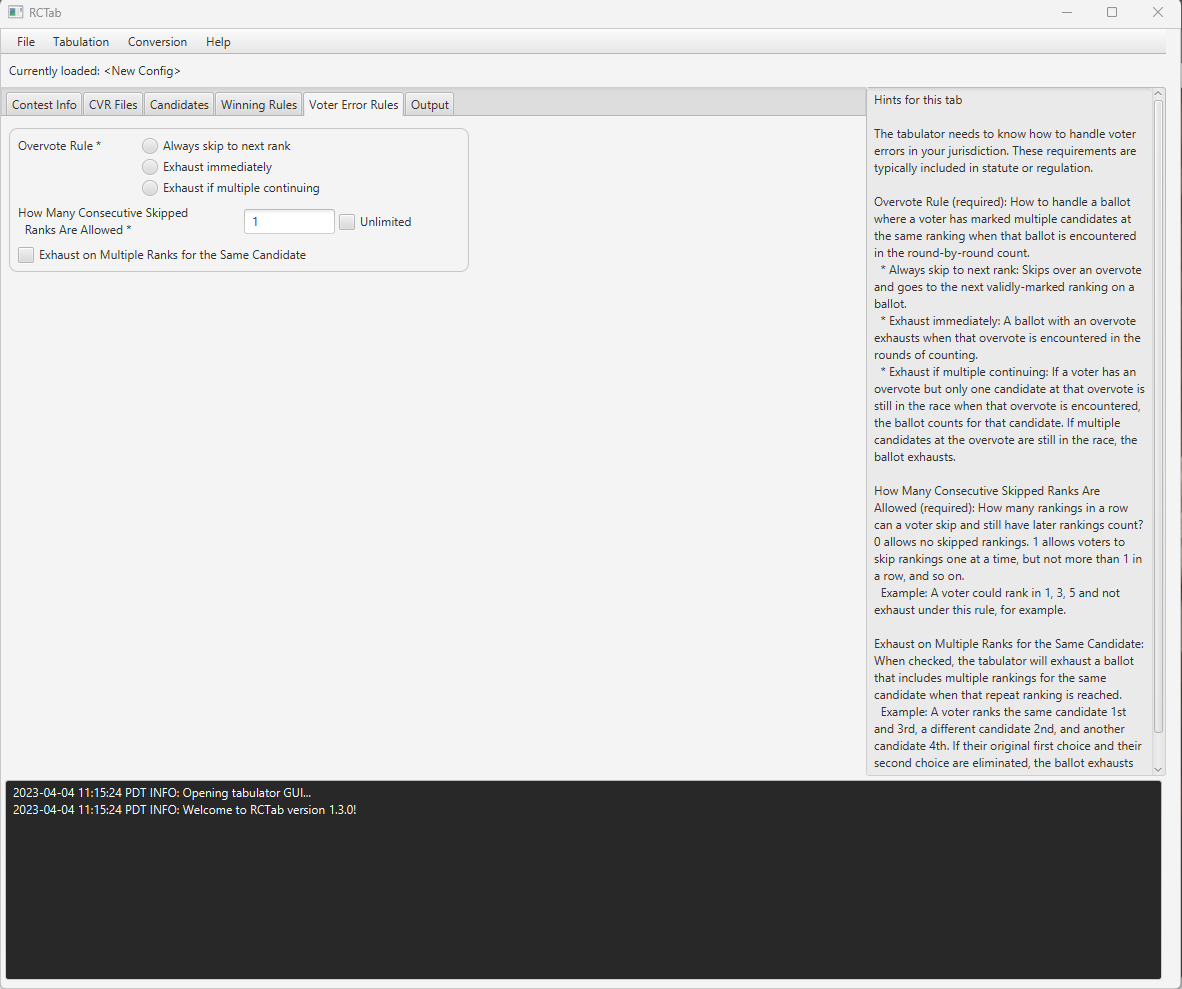
Overvote Rule (required): Users have the option to select how to handle a ballot where a voter has marked multiple candidates at the same ranking when that ballot is encountered in the round-by-round count. The options are:
-
Always skip to next rank
-
Exhaust immediately
-
Exhaust if multiple continuing
How Many Consecutive Skipped Ranks Are Allowed (required): Users are given the option to select how many rankings in a row can a voter skip and still have later rankings count. 0 allows no skipped rankings, while 1 allows voters to skip rankings one at a time, but not more than 1 in a row, and so on.
The Unlimited checkbox allows for an unlimited number of skipped rankings.
Exhaust on Multiple Ranks for the Same Candidate (optional): When checked, the tabulator will exhaust a ballot that includes multiple rankings for the same candidate when that repeat ranking is reached.
Output Tab
Tell the tabulator where results files go and what additional results files you want. This is a screenshot of what output looks like when a user first navigates to it.
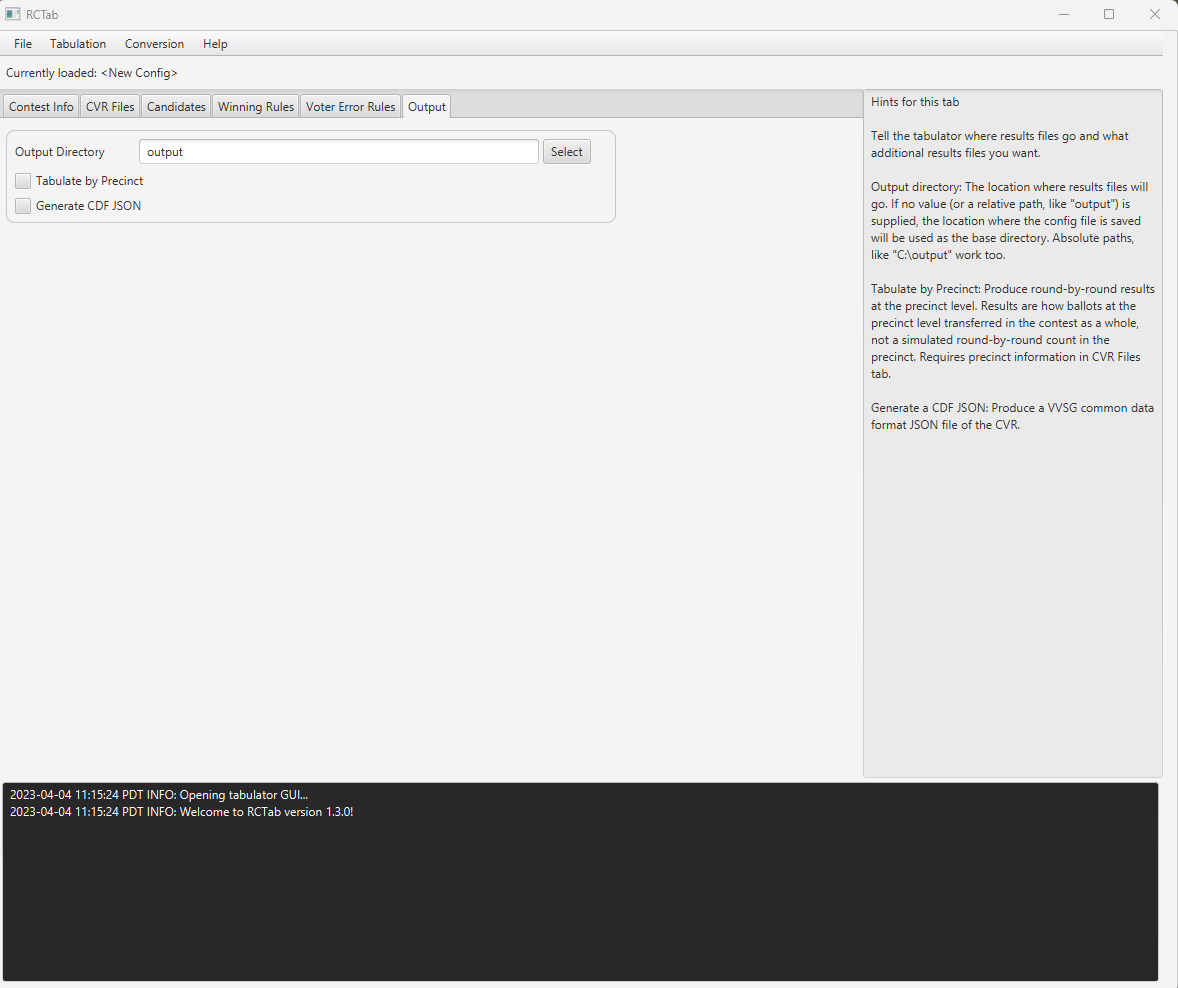
Output directory: One folder per contest tabulated should be created. Output directory instructs RCTab where to save any output files from successful RCTab tabulations. This is the location where results files will go. If no value (or a relative path, like "output") is supplied, the location where the config file is saved will be used as the base directory. Absolute paths, like "C:\output" work too. Select allows users to navigate through Explorer to select a location.
RCTab will not allow the output path to be configured to a Windows user account folder (by default anything under the path c:\users\. This requirement ensures read-only output. You must follow the instructions in RCTab v1.3.2 Section 22 - Installation Instructions for Windows OS v.1.2.2 to set permissions on the output folder. Following these instructions ensures that the ‘RCTab’ user account cannot edit or delete RCTab summary output files or audit logs.
Tabulate by Precinct: This checkbox allows RCTab to produce round-by-round results at the precinct level. However, the CVR file must contain precinct information for this to function correctly.
Generate a CDF JSON: Produces a VVSG common data format JSON file of the CVR.
Generating Results Files
Validating Configuration files
Once a configuration file is successfully created, the user must validate the configuration file.
-
Click on “Tabulation” at the top of the software window
-
Click on “Validate”
-
Refer to the log box at the bottom of the application. If the message “Contest config validation successful.” appears, your contest configuration has been successfully completed.
-
If any error messages appear in the log box, refer to RCTab v1.3.2 Section 29 - RCTab Operator Log Messages v.1.2.2 and messages in the log box for how to resolve errors. If the error persists, restart RCTab software
Saving Configuration Files
Once ready to run a tabulation, the user must first save the configuration file.
-
Click on “File” at the top of the software window
-
Click on “Save…”
-
Select a location to save the configuration file. manufacturer suggests users save the configuration file to the same location set in the Output Directory setting.
-
Refer to the log box at the bottom of the application. If the message “Successfully saved file: Filepath” your configuration .json file has been successfully saved.
-
If any error messages appear in the log box, refer to RCTab v1.3.2 Section 29 - RCTab Operator Log Messages v.1.2.2 and messages in the log box for how to resolve errors. If error persists, restart RCTab software.
Running a Tabulation
Once a configuration is saved, the user is ready to run a tabulation.
-
Click on “Tabulation” at the top of the software window
-
Click on “Tabulate”
-
Tabulation will begin.
-
If all above steps were successfully completed, Tabulation will run until complete.
-
Tabulator log box will update with messages as Tabulation proceeds.
-
Once complete, Tabulator log box will display message stating “Results written to: [filepath from Output Directory]”
Output files will be:
-
.csv contest summary files
-
summary.csv Whole-contest summary files
-
summary.csv.hash Corresponding hash file. This contains the hash to verify the results in summary.csv
-
Precinct-by-precinct summary files (if tabulating by precinct)
-
-
.json contest summary files
-
summary.json Whole-contest summary files
-
summary.json.hash Corresponding hash file. This contains the hash to verify the results in summary.json
-
Precinct-by-precinct summary files (if tabulating by precinct)
-
-
.log audit files
-
.log audit files are exported in 50MB sections. If a .log file exceeds 50MB an additional .log file is started by RCTab
-
Corresponding audit_N.log.hash file. This contains the hash to verify the information in each audit_N.log file
-
-
.json CDF (common data format) files if Generate a CDF JSON is checked
More information about results files is available in RCTab v1.3.2 Section 02 - Software Design and Specifications v.1.4.2. If necessary, instructions for verifying result file hashes can be found in RCTab v1.3.2 Section 23 - HashCode Instructions - Windows OS v.1.2.1.
Users can then navigate to “File” and click “Exit” if all contests are tabulated.
If more contests remain to be tabulated, and contests will contain fewer than 1,000,000 total votes, users can navigate to “File” and click “New.” This will clear all fields in RCTab and permit the user to create a new configuration file.
If contests to be tabulated will contain more than 1,000,000 total votes, return to start of guide and re-launch tabulator according to large configuration launch requirements. Then follow the guide to set up a configuration file.
If any errors arise in the use of RCTab, refer to RCTab v1.3.2 Section 29 - RCTab Operator Log Messages v.1.2.2. Errors arising out of any hardware or software other than RCTab should refer to RCTab v1.3.2 Section 09 - System Maintenance Manual v.1.3.2 and any relevant user and maintenance manuals.
Before publishing results, jurisdictions should use their established reconciliation procedures to ensure total votes counted in each round equals total ballots cast in the contest. If numbers in the reconciliation process do not match, user should double-check that all CVRs for that contest were exported successfully from the voting system and run RCTab process for that contest again. Rely on user jurisdiction CVR handling procedures for transmitting CVRs.
Any interaction with RCTab, including producing configuration files, running tabulations, hashing results files, and transmission of files from RCTab on USB drives should follow transmission procedures required in the jurisdiction, including the use of a team with no less than two trained personnel.
Required capabilities that may be bypassed or deactivated during installation or operation by the user shall be clearly indicated.
Additional capabilities that function only when activated during installation or operation by the user shall be clearly indicated.
Additional capabilities that normally are active but may be bypassed or deactivated during installation or operation by the user shall be clearly indicated.
The installation process for RCTab does not give users the opportunity to bypass or deactivate options or settings.
Capabilities that are active or inactive in software operation depend on various factors. Many of these factors are laid out above. Configuration files determine which system capabilities apply to a given set of voting data. More information about operations that users can set through the user interface is provided in RCTab v1.3.2 Section 25 - Configuration File Parameters v.1.1.1. Information about operation of those settings is also provided in RCTab v1.3.2 Section 02 - Software Design and Specifications v.1.4.2.
Configuration File Parameters and UI Label Match Sheet
Below is a list of all configuration file parameter labels and their corresponding labels in the RCTab UI. Labels are organized by the order of their appearance in the RCTab UI.
Configuration File Parameters Name/Label | UI Name/Label
contestName | Contest Name
contestDate | Contest Date
contestJurisdiction | Contest Jurisdiction
contestOffice | Contest Office
rulesDescription | Rules Description
provider | Provider
cdf | CDF
clearBallot | Clear Ballot
Dominion | Dominion
ess | ES&S
hart | Hart
filePath | Path
contestId | Contest ID
firstVoteColumnIndex | First Vote Column
firstVoteRowIndex | First Vote Row
idColumnIndex | ID Column
precinctColumnIndex | Precinct Column
overvoteDelimiter | Overvote Delimiter
overvoteLabel | Overvote Label
undervoteLabel | Undervote Label
undeclaredWriteInLabel | Undeclared Write-in Label
treatBlankAsUndeclaredWriteIn | Treat Blank as Undeclared Write-In
name | Name
code | Code
excluded | Excluded
winnerElectionMode | Winner Election Mode
singleWinnerMajority | Single-Winner Majority Determines Winner
multiWinnerAllowOnlyOneWinnerPerRound | Multi-Winner Allow Only One Winner Per Round
multiWinnerAllowMultipleWinnersPerRound | Multi-Winner Allow Multiple Winners Per Round
bottomsUp | Bottoms-up
bottomsUpUsingPercentageThreshold | Bottoms-up using Percentage Threshold
multiPassIrv | Multi-Pass IRV
maxRankingsAllowed | Maximum Number of Candidates That Can Be Ranked
minimumVoteThreshold | Minimum Vote Threshold
batchElimination | Use Batch Elimination
continueUntilTwoCandidatesRemain | Continue Until Two Candidates Remain
tiebreakMode | Tiebreak Mode
random | Random
stopCountingAndAsk | Stop counting and ask
previousRoundCountsThenRandom | Previous Round Counts (then random)
prevousRoundCountsThenAsk | Previous Round Counts (then stop counting and ask)
useCandidateOrder | Use candidate order in config file
generatePermutation | Generate permutation
randomSeed | Random Seed
numberOfWinners | Number of Winners
multiSeatBottomsUpPercentageThreshold | Percentage Threshold
nonIntegerWinningThreshold | Compute using HB Quota >(Votes/ (Seats + 1))
hareQuota | Compute using Hare Quota =(Votes/Seats)
decimalPlacesForVoteArithmetic | Decimal Places for Vote Arithmetic (Multi-Winner Only)
overvoteRule | Overvote Rule
alwaysSkipToNextRank | Always skip to next rank
ExhaustImmediately | Exhaust Immediately
exhaustIfMultipleContinuing | Exhaust if multiple continuing
maxSkippedRanksAllowed | How Many Consecutive Skipped Ranks Are Allowed
exhaustOnDuplicateCandidate | Exhaust on Multiple Ranks for the Same Candidate
outputDirectory | Output Directory
tabulateByPrecinct | Tabulate by Precinct
generateCdfJson | Generate CDF JSON
| Document Revision History | |||
|---|---|---|---|
| Date | Version | Description | Author |
| 09/28/2023 | 1.2.2 |
|
Mathew Ruberg |
| 04/28/2023 | 1.2.1 | Updated to reflect RCTab v1.3.1 | Kelly Sechrist |
| 04/04/2023 | 1.2.0 | Updated to Reflect RCTab v.1.3.0 | Rene Rojas |
| 01/19/2022 | 1.1.0 | Revisions for clarity | Ryan Kirby |
| 04/27/2021 | 1.0.0 | System Operations Procedures | Chris Hughes |